Overall Status Summary
As of Friday, October 3, 2025
Phase 1: Establish Foundation & Framework – 80% Complete (prior report was 40%)
Key activities are progressing well. A website (https://varnvilleginbuildingstudy.com/) has been active and received X # of visits. SSI is close to finishing its research on community demographics, the building’s historical significance, and the cotton-ginning industry of the late 19th and early 20th centuries.
In September, SSI began documenting gaps in community services that might be addressed by repurposing the Cotton Gin building. We have been engaging directly with Varnville and Hampton County residents, as well as leaders who influence activities across Hampton County.
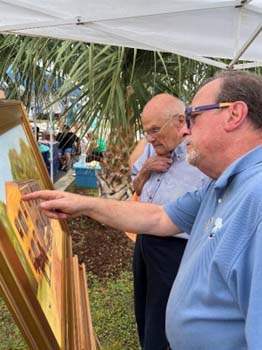
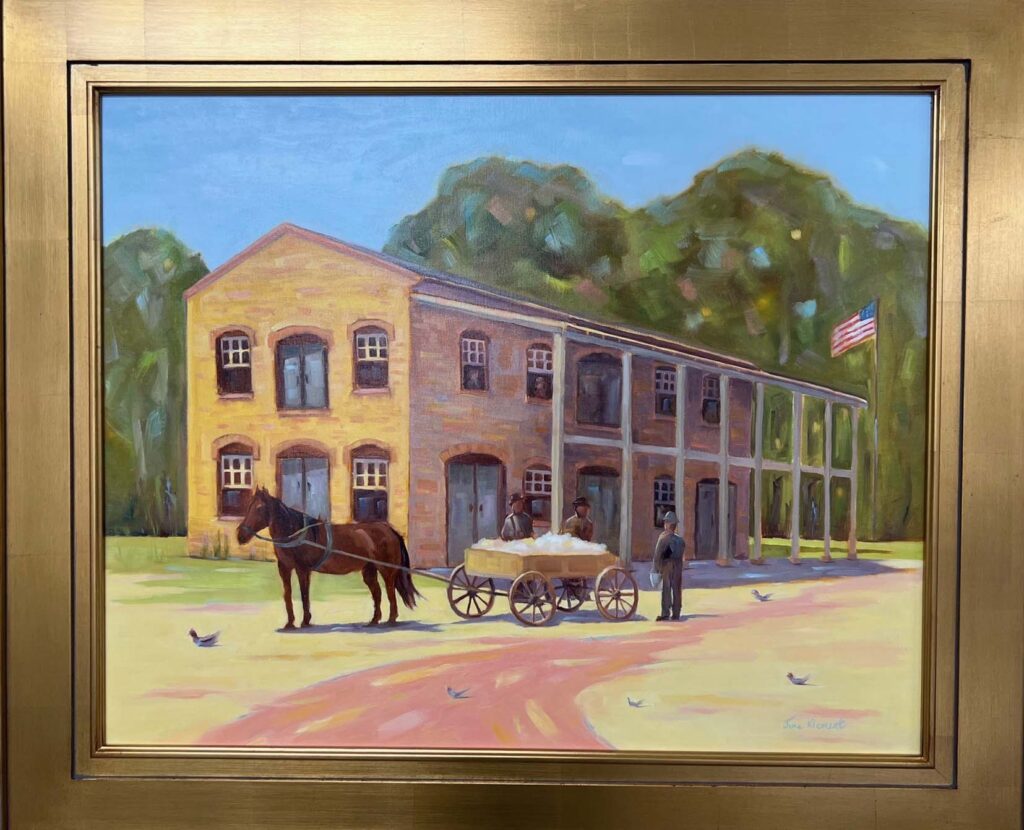
We attended the Varnville City Fun Day, where we distributed flyers and collected seven survey responses. The impressionistic oil painting of the Cotton Gin building, as it appeared in its operational days, was displayed, which generated some interest in the project.
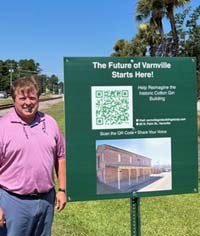
SSI completed two trips to Varnville in September. To install a sign encouraging participation in the survey and generating interest in the project, and to meet with two ministers: Jack
Hutto, minister of the United Methodist Church of Varnville and Hampton, and Tom Kelly, minister of the First Baptist Church of Varnville. Nat Shaffer provided the sign location and posed for a photograph that was used in a LinkedIn post. The LinkedIn post has received 254 impressions. An earlier LinkedIn post announcing the study has received 592 impressions. The second trip was to participate in the Varnville City Fun Day, where Lee Wheatley interviewed Jimmy Ginn, a 93-year-old former resident of Varnville. Lee is in the foreground with Jimmy in the background of the photo with the cotton gin building painting.
Phase 2: Define Alternatives – 40% Complete (prior report was 10%)
While additional community input is needed to confirm service gaps and identify priority functions, SSI continued to frame potential uses for the repurposed facility. All alternatives under consideration include:
- A literacy center for tutoring both children and adults,
- A multi-use space with senior programs, arts and crafts, and other educational offerings,
- A Farmers Market
- A community garden.
Several broad alternatives have been identified based on space requirements:
- Incorporating a commercial kitchen,
- Establishing a small spirits production facility,
- Using the entire space for training and events.
- Providing the space for a restaurant/caterer
- Providing space for a business incubator
Layouts have been generated that incorporate the above alternatives as well as draft write-ups explaining these.
Phase 3: Develop and Evaluate Preferred Option – Not Yet Initiated
Status Against Project Scope (Activities)
Phase 1: Establish Foundation & Framework (July – October 2025) Activities
- Clarify and confirm project scope, objectives, and
STATUS: Completed on 8-12-25 via attending the Varnville Town Council meeting and the kick-off meeting (July 25th). Documented within the website.
- Gather baseline data on demographics, economy, zoning, and tourism
STATUS: Have initiated documentation of Demographics (90% Complete)
- Identify and involve stakeholders
STATUS: Refined Excel sheets by adding additional stakeholders. Listed all churches within Varnville City, Museums within Varnville and Hampton County, started a list of all businesses registered within Varnville City, Educational and medical within Hampton County, Commercial kitchens within 150 miles of Varnville and specific individuals (e.g., Varnville Mayor and town council), etc. (60% Complete)
- Gather historic photos of the Gin and Lowcountry
STATUS: Contacted museums located within Hampton County (60% Complete)
- Identify potential partners (Hampton County School District (HCSD), University of South Carolina (USC) Salkehatchie, Technical College of the Lowcountry (TCL), South Carolina (SC) Works, industries, nonprofits, youth organizations)
Status: Held telephone interview with Dean April Cone, USC Salkehatchie, Victoria Powell with Hampton County First Steps, Executive Director Kara Meador with the Original 6 Foundation which provides an after school program for 2nd through 8th graders, Colleen Russell with the Hampton County Council on Aging, and the Hampton County Library which no longer provides a tutoring program (in past years it had offered an online program). Faye
Gooding, Lee Wheatley, and Bill Jackson attended a tour of the Augusta HUB facilities and programs.
- Perform market demand
STATUS: Initiated (10% Complete)
- Demographics, income, employment
STATUS: Documented based on internet searches, but has not been confirmed with the Varnville City. (90% Complete)
- Gaps in services such as retail, childcare, training, nutrition, and
STATUS: Initiated, estimate (70% complete)
- Competition and demand drivers (tourism, underserved needs)
STATUS: Initiated, associated with Education, estimate (70% complete)
- Create and launch a survey to help engage stakeholders and gather market research. STATUS: Completed, launched 8-22-25 (100% Complete), have obtained 12 surveys and are attempting to obtain more.
- Document bounding functions and requirements
STATUS: Being developed as alternatives are identified, estimate (40% complete)
- Create a project website to promote transparency, encourage community involvement, and facilitate information sharing.
STATUS: Completed, launched 8-22-25 (100% Complete) 123 people have visited the website
- Attended Varnville City Fun Day, a small-town celebration, to help engage general
STATUS: Established a 10 x 10 booth and provided information associated with the study to festival attendees and all vendors. (100% Complete)
Deliverables
- Stakeholder List & Engagement Notes
STATUS: List being developed (as noted above), Initiated contacting individuals and organizations and documenting the discussions (40% Complete)
- Baseline data report (demographics, economy, zoning, tourism)
STATUS: Started documentation in separate files but not into a report format yet (30% complete)
- Website live with project overview, timeline, surveys, flyer, and
STATUS: Completed, launched 8-22-25 (100% Complete)
Phase 2: Define Alternatives (August – December 2025) Activities
- Conduct at least two listening sessions and stakeholder workshops
STATUS: In process of establishing dates, post distribution of flyers, and Sept 27th Festival (5% Complete)
- Identify 3–5 realistic adaptive reuse options (e.g., Workforce Hub, Heritage Museum, Business Incubator, Food Innovation Center, Training Center, Distillery).
STATUS: In development of three alternatives, rough layouts have been created, including equipment (80% complete)
- Estimate square footage & target audiences
STATUS: Rough layouts within square footage for five alternatives have been completed, and target audiences identified (80% Complete)
Status of Remaining Phase 2 Activities: Minimal documentation, verbal discussions have occurred
- Define services and community/economic value
- Develop ROM for capital and operating costs for each
STATUS: Developed ROM cost estimates to stabilize building and initiated defining costs for alternatives (60% Complete)
- Forecast ROM revenue sources (leases, sales, rentals, grants, donors)
- Conduct financial analysis of 10-year ROM cash flows
- Assess the economic and social impact (such as jobs created, households served, and ripple effects)
- Identify funding and financing options (grants, public-private partnerships, tax credits, debt options)
- Prepare a business case for each
- Risk assessment and handling strategies
STATUS: Initiated identification of threats and handling strategies for each alternative (50% Complete)
- Executive summary, space allocation strategies, and cost/revenue models
Deliverables
- Stakeholder Workshop Summaries
- Conceptual design packages for
Status: Initiated and started refining (50% Complete)
- ROM Cost and Revenue Projections
- Risk Assessment Report
- Business cases for each alternative
Phase 3 STATUS: Have not started any activities within Phase 3 Phase 3: Evaluation & Recommendation (January – March 2026) Activities
- Engage key stakeholders to reduce options to the top
- Verify that requirements are
- Develop evaluation criteria (economic, cultural, sustainability)
- Implement the Analytic Hierarchy Process (AHP) modeling
- Pairwise comparisons
- Sensitivity analysis
- Prepare the final recommendation report with a ranked
- Hold an in-person briefing with Town leadership and
Deliverables
- AHP Decision Models and Documentation
- Draft Feasibility Study (February 2026)
- Final Feasibility Study with Implementation Roadmap (March 2026)
- In-person briefing for Varnville town leadership
Ongoing Deliverables (July 2025 – March 2026)
- Biweekly & Monthly Status Reports
- Stakeholder engagement reports
- Website updates on progress, surveys, and
Final Completion: March 2026
- Final report delivered and presented
- Stakeholders validate recommendations
Study concludes with a roadmap for implementation