Purpose of the Gin Feasibility Study
Success Staging International (SSI) has been hired to carry out a comprehensive feasibility study for the historic Cotton Gin building in downtown Varnville. The study aims to determine the most effective and sustainable uses of this landmark to benefit the community.
What the Study Will Do
- Assess Opportunities: Review local, regional, and state demographic and economic data to determine the best potential uses for the building.
- Explore Design Options: Consider how the 5,000 sq. ft., two-story facility could include food service, retail, offices, education, childcare, wellness services, museum displays, event space, arts and crafts, and more.
- Build Partnerships: Collaborate with local schools, universities, health and wellness providers, industrial and retail partners, and state agencies to explore opportunities for cooperation.
- Guide Future Development: Create a roadmap to stabilize and renovate the building, establish leasing and operating agreements, and ensure long-term sustainability.
Goals and Outcomes
- Create opportunities for both new and existing businesses.
- Promote education, workforce growth, and community health.
- Increase revenue for the Town of Varnville through local business activity.
- Foster community pride, celebrate local history, and develop future leaders.
- This study will lay the groundwork for turning the Gin into a center of economic, cultural, and social activity for Varnville and Hampton County.
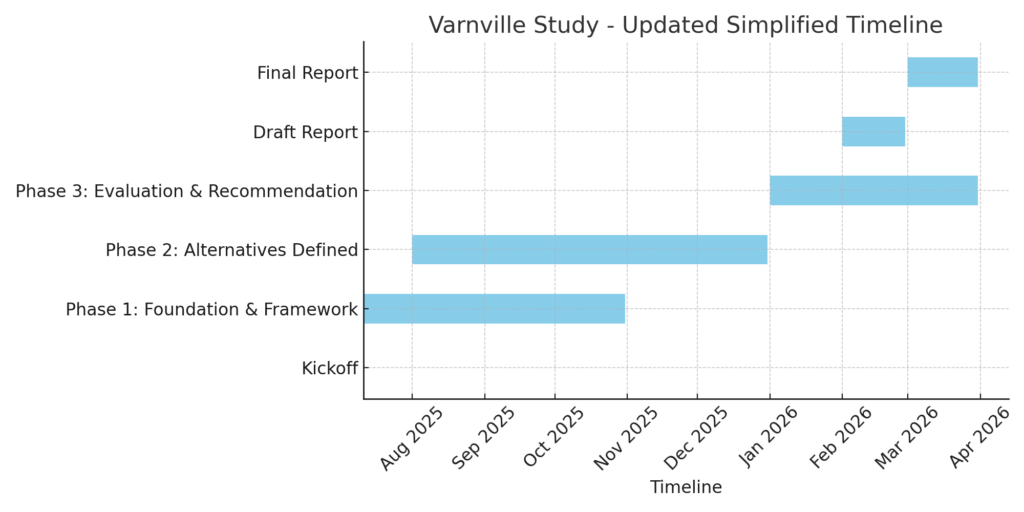
Phase 1: Establish Foundation & Framework (July – October 2025)
Activities
- Clarify and confirm project scope, objectives,, and goals.
- Gather baseline data on demographics, economy, zoning, and tourism potential.
- Identify and involve stakeholders
- Gather historic photos of the Gin and Lowcountry culture.
- Identify potential partners (Hampton County School District (HCSD), University of South Carolina (USC) Salkehatchie, Technical College of the Lowcountry (TCL), South Carolina (SC) Works, industries, nonprofits, youth organizations)
- Perform market demand analysis.
- Demographics, income, employment
- Gaps in services such as retail, childcare, training, nutrition, and education.
- Competition and demand drivers (tourism, underserved needs)
- Create and launch a survey to help engage stakeholders and gather market research.
- Document bounding functions and requirements
- Create a project website to promote transparency, encourage community involvement, and facilitate information sharing.
- Attend Varnville City Fun Day, a small-town celebration, to help engage general stakeholders.
Deliverables
- Stakeholder List & Engagement Notes
- Baseline data report (demographics, economy, zoning, tourism)
- Website live with project overview, timeline, surveys, flyer, and updates.
Phase 2: Define Alternatives (August – December 2025)
Activities
- Conduct at least two listening sessions and stakeholder workshops
- Identify 3–5 realistic adaptive reuse options (e.g., Workforce Hub, Heritage Museum, Business Incubator, Food Innovation Center, Training Center, Distillery).
- Estimate square footage & target audiences
- Define services and community/economic value
- Develop ROM for capital and operating costs for each alternative.
- Forecast ROM revenue sources (leases, sales, rentals, grants, donors)
- Conduct financial analysis of 10-year ROM cash flows
- Assess the economic and social impact (such as jobs created, households served, and ripple effects)
- Identify funding and financing options (grants, public-private partnerships, tax credits, debt options)
- Prepare a business case for each alternative.
- Risk assessment and handling strategies
- Executive summary, space allocation strategies, and cost/revenue models
Deliverables
- Stakeholder Workshop Summaries
- Conceptual design packages for alternatives.
- ROM Cost and Revenue Projections
- Risk Assessment Report
- Business cases for each alternative
Phase 3: Evaluation & Recommendation (January – March 2026)
Activities
- Engage key stakeholders to reduce options to the top three.
- Verify that requirements are met.
- Develop evaluation criteria (economic, cultural, sustainability)
- Implement the Analytic Hierarchy Process (AHP) modeling
- Pairwise comparisons
- Sensitivity analysis
- Prepare the final recommendation report with a ranked portfolio.
- Hold an in-person briefing with Town leadership and stakeholders.
Deliverables
- AHP Decision Models and Documentation
- Draft Feasibility Study (February 2026)
- Final Feasibility Study with Implementation Roadmap (March 2026)
- In-person briefing for Varnville town leadership
Ongoing Deliverables (July 2025 – March 2026)
- Biweekly & Monthly Status Reports
- Stakeholder engagement reports
- Website updates on progress, surveys, and documents.
Final Completion: March 2026
- Final report delivered and presented
- Stakeholders validate recommendations
- Study concludes with a roadmap for implementation
The following have been identified so far as Key Stakeholders responsible for participating in the evaluation of alternatives and representing the residents of Varnville City and surrounding communities.
Nat Shaffer, Mayor, Varnville City
Faye Gooding, Varnville City Council Member
Henry (Alex) Campbell, Varnville City Council Member
Joseph Williams, Varnville City Council Member
Ronald Williams, Varnville City Council Member
Linda Cooler, Varnville City Council Member
Nick Ginn, Varnville City Council Member